


 http://www.hospitalprocedures.org/sto...
Internal Jugular Line Video
The patient is placed in trendelenburg position and the head is turned to the contralateral side. The skin is now being marked to display the anterior cervical triangle which is bordered by the clavicle inferiorly and the sternal and clavicular heads of the sternocleidomastoid medially and laterally.
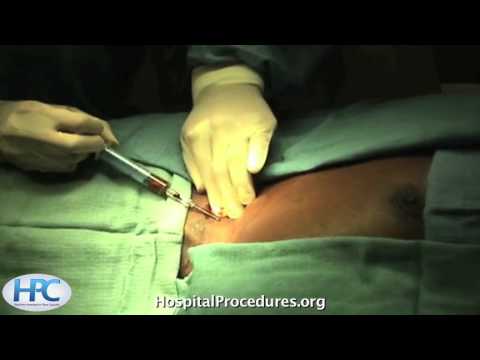
The area is now prepped with Chlorahexidine swab and sterilely draped keeping the ipsilateral nipple exposed. This is the dual lumen dialysis catheter kit. At this point 1% lidocaine is drawn up to be used for anesthesia and is now being injected to anesthetize the skin and underlying soft tissue. As the needle is advance, constant negative aspiration is utilized so we don't have an intra-arterial injection. The left hand is palpating the carotid pulse, and the finder needle is inserted just lateral to the carotid pulse aimed at the ipsilateral nipple. The finder needle is left in place. The introducer needle is then introduced just posterior to the finder needle at 30 to 40 degree angle to the skin again aiming at the ipsilateral nipple. As the introducer needle is advanced in the soft tissue space, constant negative aspiration is utilized until good venous blood return is obtained. Once you have good venous blood flow, the hub of the needle is grasped, the syringe is rotated and withdrawn and we assure that we have non-pulsatile purple venous blood flow. The wire is then introduced into the needle. It currently is being introduced in the wrong direction with the curve directed laterally, so with this method the wire is probably entering the right subclavian vein and at some point they're going to meet resistance.
The wire therefore is withdrawn back into its container. A syringe is then re-introduced onto the needle and we assure that we have good venous blood return and we again introduce the wire, this time the wire is advanced with the curve directed medially, which is the proper direction with a right internal jugular catheter placement.
The wire is advanced without any resistance. If resistance is felt at any point the wire has to be withdrawn. However, this time the wire is being introduced without any resistance.
Ideally, with either subclavian vein or internal jugular catheter placement, constant cardiac monitoring is preferred to assess for any atrial or ventricular dysrhythmias that occur while the wire is in place, as the wire can sometimes be advanced into the right atrium or right ventricle.
The needle has now been removed, the wire has been left in place, and the scalpel is used to knick the skin. A dilator is now introduced over the wire which is being held distal to the dilator and the dilator is advanced with a twisting motion, being held at the proximal end. After a subcutaneous tract has been dilated, the dilator is removed, and the catheter is now advanced over the wire. The catheter has been pre-flushed with saline in both of its ports. The wire is withdrawn into the catheter until the wire can be grasped at the distal end of one of the hubs, which is always the blue hub in the dual lumen dialysis catheters.
The catheter is advanced all the way to the blue hub and then the wire is removed and the port clamp is clamped.
Now each of the ports is flushed with saline. The syringe full of saline is introduced onto the hub, and then the port clamp is unclamped, it is flushed and then reclamped.
Each of the ports is flushed until it is completely clear without any blood. Heparin 1,000 units per ML are also used to keep each of the ports patent and each port is filled with a pre-designated amount of concentrated heparin after it is flushed with saline. The hub is then secured to the skin on two sides with suture as being shown here. Multiple passes are made through each side of the hub and a surgeon knot is made on each side.
This is carried out on both sides so that we have the catheter secured to the skin in two locations.
Internal Jugular Line Video procedures and processes | |
| 5 Likes | 5 Dislikes |
| 5,935 views views | 583 followers |
| Education | Upload TimePublished on 1 Sep 2012 |

Không có nhận xét nào:
Đăng nhận xét